
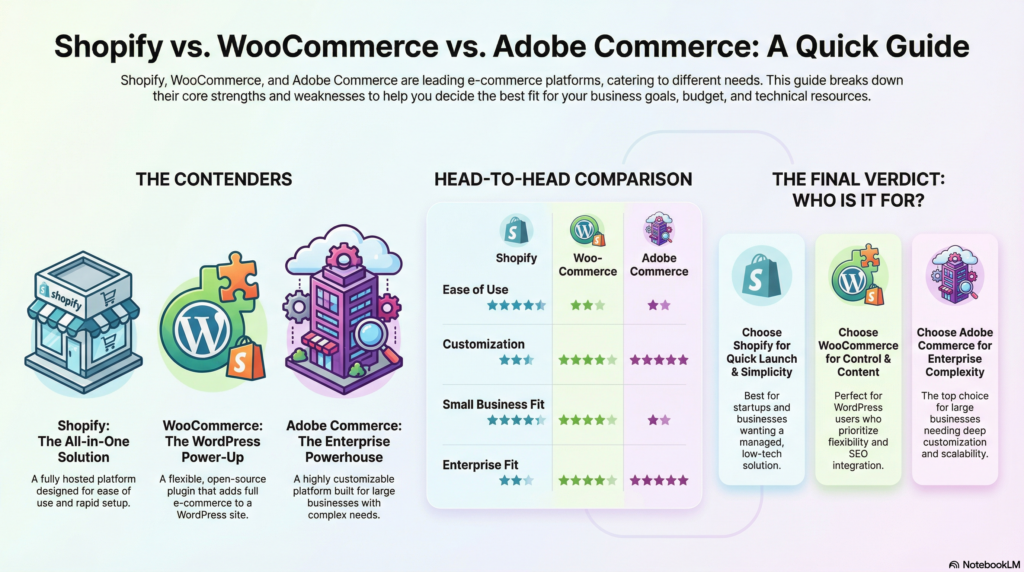
🔍 1. Overview of Platforms
📦 Shopify
A fully hosted SaaS (Software as a Service) platform that lets you build and run online stores without managing servers or infrastructure. Known for simplicity and reliability. (Previse)
🛠️ WooCommerce
An open-source e-commerce plugin for WordPress. You host and manage everything yourself, giving flexibility and control — ideal for WordPress users. (Previse)
⚙️ Adobe Commerce (Magento 2)
A highly customizable, enterprise-grade open-source e-commerce platform. Adobe Commerce refers to the commercial licensed version, while Magento Open Source is the free core. (Previse)
✅ 2. Benefits
Shopify
Ease of Use: Designed for beginners; intuitive dashboard and setup — no coding required. (Websnow Technologies)
Managed Hosting & Security: Hosting, SSL, backups, and security are handled for you. (Previse)
Support: 24/7 support included (chat, email, phone). (TekRevol)
Built-in e-commerce Tools: Store builder, marketing features, POS integration, and multichannel selling. (Previse)
App Ecosystem: Thousands of apps to extend store functionality. (Forbes)
👉 Excellent choice if you want a quick, low-friction store launch and minimal technical overhead.
WooCommerce
High Customization: Full control over design and functions via WordPress. (Websnow Technologies)
Content + Commerce: Ideal if your store is content-driven (blogs, SEO-focused). (Websnow Technologies)
Open-Source Freedom: No licensing fees; extend with plugins or custom code. (Previse)
Large Plugin Ecosystem: WordPress and WooCommerce plugins for almost every feature. (Reddit)
👉 A strong option when you want flexibility and control, especially with existing WordPress sites.
Adobe Commerce (Magento 2)
Maximum Customization: Deep control over almost every aspect of the online store. (Adobe Business)
Scalability & Complex Requirements: Built to handle very large catalogs, multi-site, multi-region, and complex business processes. (Adobe Business)
Enterprise Features: Advanced marketing, customer segmentation, personalization, multi-store support. (Forbes)
Strong B2B Support: Tools tailored for wholesale or B2B workflows. (Adobe Business)
👉 Best for large enterprises or businesses with complex workflows and development resources.
💰 3. Cost Comparison
Platform
Licensing & Hosting
Development / Maintenance
Other Costs
Shopify
$39–$399+/mo; Plus ~ $2,000+/mo (enterprise) (Previse)
Low
Apps, themes, transaction fees (Previse)
WooCommerce
Free plugin + hosting (~$5–$150+/mo) (Previse)
Moderate (themes/plugins)
Plugins, developer time (Previse)
Adobe Commerce
Open Source free; Adobe Commerce ~ $22,000+/yr license (Previse)
High (developers)
Hosting, extensions (Previse)
Notes:
Shopify’s subscription is predictable but apps & transaction fees can add up. (Tekglide)
WooCommerce appears free upfront but total can rival Shopify once hosting, plugins, and work hours are counted. (Previse)
Adobe Commerce costs the most overall due to licensing and required expert development. (Previse)
⚙️ 4. Customization
Shopify
Moderate Customization: You can customize themes and add apps, but platform limitations apply (Liquid language). (Adobe Business)
Less ideal for deep backend logic changes or highly unique workflows.
WooCommerce
High Customizability: Because it’s open-source on WordPress, you can build almost any functionality. (Websnow Technologies)
You manage extensions and plugins directly.
Adobe Commerce
Very High Customization: Full access to codebase, modules, integrations. (Adobe Business)
Ideal for bespoke features, custom product types, and complex automation.
Summary:
📌 Shopify — good for design tweaks & apps.
📌 WooCommerce — excellent flexibility via WordPress.
📌 Adobe Commerce — ultimate customization for complex enterprises.
🧑💼 5. Suitability: Small to Large Business
Small Businesses & Startups
Best Fit: Shopify — fastest setup and managed solution. (Websnow Technologies)
WooCommerce is possible but needs hosting skills; Adobe Commerce is overkill for most small stores. (TekRevol)
Growing / Mid-Sized Businesses
WooCommerce works well if tied to WordPress and SEO/content strategy. (Websnow Technologies)
Shopify scales nicely with plans like “Advanced” and “Plus.” (Previse)
Large Enterprises
Adobe Commerce (Magento 2) is best for complex catalogs, global stores, multi-store management. (Adobe Business)
Shopify Plus can serve larger volumes too but may still lag in deep customization.
🚀 6. Performance & Scalability
Shopify
✅ Fast performance by default — hosted CDN & optimized infrastructure. (Previse)
👎 Major outages (e.g., Cyber Monday 2025) can affect merchants because the backend is centralized. (TechRadar)
WooCommerce
✅ Performance depends on hosting quality and optimization (caching/CDN). (iSync Evolution)
🛠️ Requires careful maintenance for high traffic.
Adobe Commerce
✅ Built to handle high traffic and large catalogs if hosted and configured properly. (iSync Evolution)
⛔ Requires powerful servers, caching layers, and expert setup.
Scalability Summary:
Shopify — great out of the box; WooCommerce — flexible but hosting dependent; Adobe Commerce — highest performance potential with correct optimization.
📊 Quick Comparison Table
Factor
Shopify
WooCommerce
Adobe Commerce
Ease of Use
⭐⭐⭐⭐⭐
⭐⭐⭐
⭐⭐
Cost (Entry)
⭐⭐⭐
⭐⭐⭐⭐
⭐⭐
Customization
⭐⭐⭐
⭐⭐⭐⭐
⭐⭐⭐⭐⭐
Small Business Fit
⭐⭐⭐⭐⭐
⭐⭐⭐⭐
⭐⭐
Enterprise Fit
⭐⭐⭐
⭐⭐⭐⭐
⭐⭐⭐⭐⭐
Performance / Scalability
⭐⭐⭐⭐
⭐⭐⭐⭐
⭐⭐⭐⭐⭐
🧠 Final Takeaways
🔹 Shopify — Best for quick launch, managed service, minimal tech effort.
🔹 WooCommerce — Best for WordPress users who want control and SEO advantage.
🔹 Adobe Commerce — Best for large enterprises or stores needing deep custom workflows.